

At first glance, a truck accident may look like a more extreme version of a car crash, just with bigger vehicles, more intense damage, and the potential for more severe injuries. But that surface-level comparison misses the real story.
Truck accidents are not just larger car accidents. They operate under a different legal framework, involve more potential defendants, generate vastly more data, and are defended far more aggressively. Understanding those differences is critical if you or a loved one is injured in a collision involving a commercial truck.
Truck Crashes Follow Different Physics
The most obvious distinction between a truck accident and a car accident is size. A fully loaded commercial truck can weigh 20 to 30 times more than a passenger vehicle. That mass, combined with a higher center of gravity and longer braking distance, changes how the vehicle behaves in emergencies.
Movements a car can recover from, like sudden braking, sharp steering, or evasive maneuvers, can destabilize a tractor-trailer. As a result, truck crashes often follow patterns rarely seen in ordinary collisions. For example:
- Underride collisions – A smaller vehicle passes beneath the trailer during impact
- Jackknife accidents – The cab and trailer fold at an angle, sometimes blocking multiple lanes of traffic
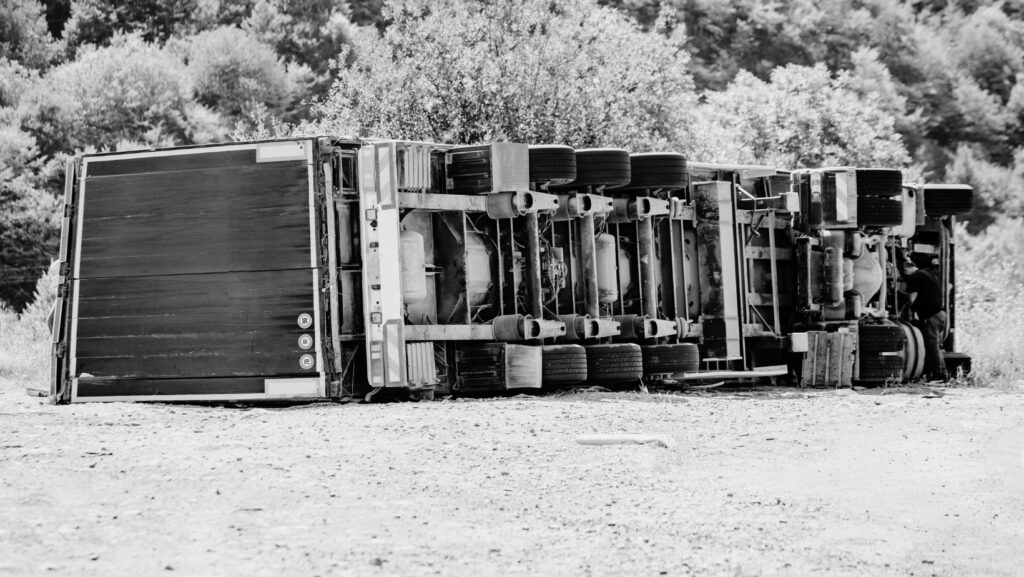
- Rollovers – When speed, curves, or load shift overcome the truck’s stability, it can tip over and cause accidents
Injuries from a truck accident can be far more severe than those in a typical car accident. Due to the size and weight of commercial vehicles, victims often suffer traumatic brain injuries, spinal cord damage, multiple fractures, and other catastrophic harm. These injuries frequently require long-term medical treatment, rehabilitation, and ongoing care, creating significant financial and personal burdens for victims and their families.
Liability in Truck Accidents Is Complex
The differences do not stop at the physics of accidents. Commercial trucking is a regulated industry, which increases the legal complexity relative to a typical accident. Drivers operate under federal and state rules. Vehicles are monitored by onboard systems that continuously record operational data. And when a crash occurs, companies and insurers often move immediately to try to control the narrative. As a result, truck accidents demand a fundamentally different legal and investigative approach than typical car crashes.
Many different parties may be responsible for an accident, including:
- the driver
- the trucking company (or “carrier”)
- cargo loaders or shippers
- maintenance contractors
- vehicle or parts manufacturers
Determining liability can be complex. The driver may have made an error, but the motor carrier may have set unrealistic schedules. Cargo loaders may have improperly balanced a load. Maintenance contractors may have failed to service critical components. In some cases, manufacturers may be responsible for defective parts.
Layered on top of this is an extensive regulatory framework. Federal trucking rules commonly involved in cases include:
- driver hours-of-service limits
- inspection and maintenance requirements
- cargo securement and weight limits
When these rules are violated, they can become powerful evidence of negligence. But identifying those violations requires familiarity with trucking regulations and the ability to trace how operational decisions contributed to the crash. Without that knowledge, critical liability pathways are often missed.
Truck Data Often Decides the Case
One of the most significant ways truck accident cases have changed in recent years is the explosion of data. Most commercial trucks are now equipped with Electronic Logging Devices that track hours of service, vehicle movement, and driver activity. Many also use telematics systems and engine control modules that record speed, braking, throttle input, and GPS location.
This data can reveal whether a driver was speeding, whether they braked before impact, how long they had been driving, and whether they were operating beyond legal limits. In many cases, it provides a far more accurate picture than eyewitness accounts alone.
However, this evidence is also fragile. Some systems overwrite data within days or weeks. Others are controlled entirely by the trucking company. There have been documented instances of altered logs, incomplete records, and ELD manipulation. That is why early action matters. Preserving electronic data often determines whether the true cause of a truck accident can be proven or whether the case relies on incomplete or disputed evidence.

Trucking Companies Start Defending Immediately
Truck accidents involve higher mandatory insurance limits than car accidents, reflecting the potential for severe injuries and property damage. While this means more coverage may be available, it also means insurers have far more incentive to fight claims aggressively. While it may feel similar at first, the reality is that handling these accidents varies significantly:
Car accident: individuals negotiating with insurers.
Truck accident: corporations defending against financial exposure.
Trucking companies and their insurers frequently deploy rapid response teams immediately after a crash. These teams may include investigators, engineers, and attorneys tasked with shaping the early narrative and limiting exposure.
In contrast, injured individuals are often dealing with medical emergencies, vehicle loss, and income disruption. Without experienced representation, they are at a significant disadvantage when negotiating against well-resourced corporate defendants. This imbalance is one of the defining characteristics of truck accident litigation.
Why Experience Changes the Outcome
Truck accident cases sit at the intersection of personal injury law, regulatory compliance, and technical evidence analysis. Not every personal injury attorney handles them, and fewer still focus on them regularly.
An experienced truck accident attorney understands how to preserve electronic evidence, identify regulatory violations, and trace responsibility across multiple parties. They know how trucking companies defend these cases and how to counter those strategies effectively. Most importantly, specialization directly affects outcomes. Missed evidence, overlooked defendants, or misunderstood regulations can significantly reduce the compensation available to an injured victim.
Working with attorneys who understand the realities of modern trucking, from telematics data to federal regulations, helps ensure that liability is fully uncovered and compensation reflects the true scope of the harm.
Kane Personal Injury has experience handling complex truck accident cases and understands the strategies used by trucking companies and insurers. The firm offers free consultations and does not charge a fee unless compensation is recovered.
If you or a loved one has been injured in a truck accident, acting quickly can make a critical difference in protecting evidence and your legal rights.