

When car accidents occur, particularly severe ones, people often have different recollections of what went wrong and why. One driver may claim they were going within the speed limit when the car crashed into someone else’s bumper. Or another driver may say they weren’t using their smartphone while driving. It may feel like a “he said, she said” situation at first, but digital evidence increasingly allows us to reconstruct an accident using hard data.
Modern vehicles, smartphones, insurance apps, navigation systems, and connected services can create a detailed record of the moments before, during, and after a crash. That car data after an accident might include speed, braking, acceleration, location, phone activity, seat belt use, and more. In a serious injury claim, understanding what vehicle data exists and preserving it before it disappears can be critical to determining what actually happened.
What Kind of Data Can Your Car Record?
Modern vehicles collect far more information than many drivers realize. In a serious crash, some of that vehicle data may help reconstruct what happened in the seconds before impact.
Many newer vehicles include an event data recorder, or EDR. According to the National Highway Traffic Safety Administration, EDRs may capture information about vehicle speed, braking, acceleration, seat belt use, airbag deployment, and other crash-related factors. The exact information available depends on the vehicle and its systems, but the data can provide a much clearer picture of how a collision unfolded.
That can be especially important when drivers give conflicting accounts. If one person says they were traveling at 35 mph and braked well before impact, available data may help confirm or challenge that version of events.
Other vehicle systems may also contain useful information. Connected-car services, navigation systems, onboard computers, and manufacturer telematics can sometimes provide additional details about location, vehicle movement, or system activity. In other words, car data after an accident may offer evidence that is difficult to recreate once it is lost.
Your Phone and Insurance App May Know Even More
Your vehicle is only one possible source of digital evidence. Phones and driving apps can also create records that help establish what someone was doing before a crash.
Phone Activity Can Matter in a Distracted Driving Case
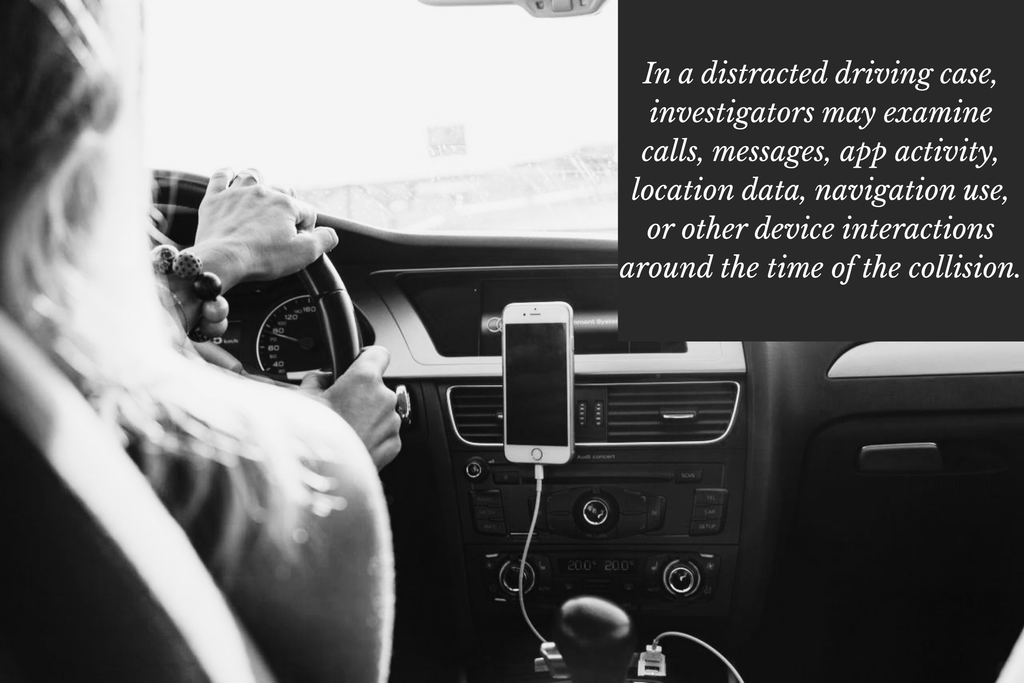
In a distracted driving case, phone records may become especially important. Depending on what information is available, investigators may examine calls, messages, app activity, location data, navigation use, or other device interactions around the time of the collision.
That evidence can help test a driver’s account of what happened. Someone may insist they weren’t using a phone immediately before a crash, but digital records may support or contradict that claim.
Insurance Apps Can Create Their Own Driving Record
Usage-based insurance programs can add another layer of information. Depending on the program, insurance app accident data may include hard braking, rapid acceleration, speed, trip timing, location, or indicators that a driver was handling a phone.
Drivers often install these apps to qualify for lower premiums, not because they expect the data to matter in an injury claim. But after a serious collision, that information may become another piece of the evidence used to reconstruct how the crash happened.
Digital Evidence Can Confirm or Contradict What Someone Says Happened
Crash investigations often begin with witness accounts, but memory is imperfect. Stress, confusion, and the speed of a collision can make it hard for anyone involved to remember every detail accurately.
Digital evidence can fill in some of those gaps. Vehicle data might show the car was traveling faster than claimed or that braking began only moments before impact. Phone records could show activity around the time of the collision. Surveillance footage, dashcam video, or app data may add even more context.
This is also why giving a recorded statement soon after an accident can carry consequences. A statement may shape how an insurer initially understands the crash, but it is not necessarily the final word. As more evidence becomes available, investigators may compare what each person said with vehicle data, phone records, video, and other objective records. That comparison can be especially important when the drivers disagree about key details. Instead of relying entirely on competing stories, digital evidence may help establish which account best matches what actually happened.
The Evidence Is Bigger Than the Car
A serious crash investigation may require looking well beyond the vehicles involved. Phone records, insurance app data, dashcam footage, traffic cameras, nearby business surveillance, 911 records, witness statements, and physical evidence from the roadway can all help establish what happened.
The challenge is that some of this evidence may not remain available indefinitely. Video can be overwritten, electronic records may be difficult to obtain later, and vehicles may be repaired or destroyed before important data is recovered. That makes early preservation especially important.
An experienced personal injury attorney can investigate the accident and identify evidence that an injured person may not realize exists. In a serious injury case, that can mean requesting records, preserving vehicle data, locating surveillance footage, and comparing multiple sources before an insurance company builds a one-sided account of the crash.
The more complicated the collision, the more important it is to build the claim around evidence rather than assumptions or potentially flawed recollections.
What Digital Evidence Could Mean for Your Injury Claim
A serious accident claim is no longer built only from police reports, photographs, and competing driver statements. Increasingly, electronic records can provide an independent account of what happened before and during a crash.
That can be especially important when liability is disputed, or an insurance company is trying to minimize what happened. Data showing speed, braking, phone activity, or other driving behavior may help strengthen a claim, challenge an inaccurate account, or reveal facts that were not obvious at the scene.
If you were seriously injured in a crash, Kane Personal Injury can investigate the available evidence and work to build a claim based on the full record, not just the insurance company’s version of events. Contact Kane Personal Injury today to discuss your case and learn what evidence may be available.