

Despite ongoing chronic pain after an accident, many victims become frustrated when an X-ray or MRI comes back normal. Insurance companies won’t pay for injuries unless they see proof, but proof is hard to provide without diagnostic imaging to back it up.
The truth is that some scans have limitations on what they can see. For instance, an X-ray doesn’t show a sprain or nerve damage, and an MRI won’t always reveal a brain injury. But a good personal injury attorney knows that just because the cause of pain can’t be seen on a screen, it doesn’t mean the injury isn’t there.
If you’ve been hurt in an accident and the other party is refusing to offer compensation because there’s no diagnostic proof, you need experienced legal representation.
Chronic Pain After an Accident Isn’t Always Visible
Accident victims don’t have to walk away with scrapes, bruises, or blood to be injured. Often, their injuries are invisible or hidden, with the cause of pain coming from the inside. A fractured bone, herniated disc, compressed nerve, or dislocated hip can cause terrible pain that requires medical attention — and that treatment can get pretty expensive. In some of these cases, accident victims are able to prove their internal injuries by getting an X-ray or CT scan. But imaging doesn’t always show where the pain is coming from, and that lack of concrete evidence can make legal action challenging.
Why an X-Ray, CT or MRI Might Come Back Normal
The purpose of an X-ray is to capture dense structures like bones. It can show fractures, dislocations, and even foreign objects, such as when a child swallows a coin. Some X-ray machines are portable, too, making them easy to roll to the bedside of a trauma patient, which is why they are usually the first line of imaging in the E.R. after an accident. But X-rays don’t reveal problems with soft tissues like muscles, ligaments, and nerves, so they won’t show injuries such as whiplash or a sprain.
A CT scan combines a series of X-rays with computer processing to create pictures of the inside of the body. It can show bones, organs, and internal bleeding, but the contrast between various forms of soft tissue can make tendon damage and ligament tears difficult to see. Even when a patient is experiencing tremendous pain due to torn muscles or ligaments, they happen at such microscopic levels that a CT can’t detect them.
Magnetic Resonance Imaging (MRI) uses a strong magnetic field and radio waves to provide detailed images of the body’s internal structures. It can reveal soft tissue problems like tendon tears, neurological conditions like a brain injury, and spinal issues such as herniated discs and pinched nerves. However, very small tears or early inflammation may not be visible on a standard MRI scan. Injured nerves may appear normal even though they are not firing as they should. And some injuries like joint stability or pain that only occurs while standing will be missed by an MRI because the patient was lying down during the scan.
Accident Injuries That Are Hard to Prove with Imaging
There are multiple types of injuries that insurance companies initially refuse to pay for after an accident; that doesn’t mean they aren’t real or that victims should give up on seeking compensation.
Nerve Injuries
Pinched nerves, nerve inflammation, and nerve injuries cause pain, numbness, tingling, and weakness without visible evidence on standard imaging. For example, a victim with whiplash may not be able to turn their head due to a nerve that’s compressed by a herniated disc. When a CT or MRI comes back normal, an EMG (electromyography) or nerve conduction study can measure how nerves function rather than how they look. These results can provide objective evidence of nerve damage.
Symptoms of nerve damage can include:
- Numbness or tingling
- Stiffness
- Shooting pain or a burning sensation
- Muscle spasms
- Weakness
- Slow reflexes
- Bladder or bowel control issues
Soft Tissue Injuries
Sprains, strains, and muscle tears are common in accidents, and some can be hard to diagnose with a scan. Instead, a soft tissue injury claim often requires a doctor’s expertise who can testify as to how the victim’s movement has been impaired; for example, not being able to put weight on a sprained ankle.
Symptoms of soft tissue injuries include:
- Pain
- Swelling
- Weakness
- Limited range of motion
Traumatic Brain Injuries
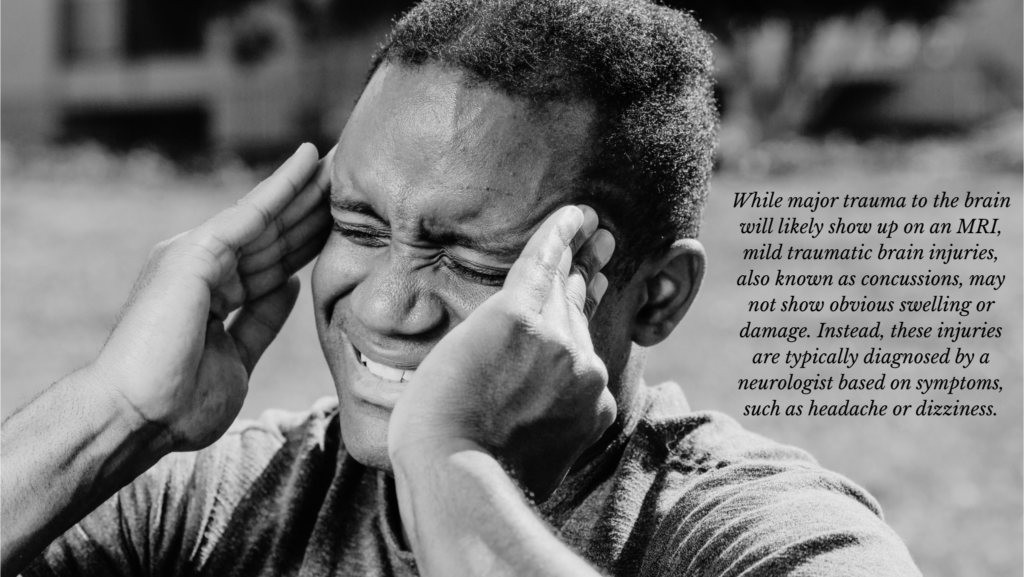
While major trauma to the brain will likely show up on an MRI, mild traumatic brain injuries, also known as concussions, may not show obvious swelling or damage. Instead, these injuries are typically diagnosed by a neurologist based on symptoms, such as headache or dizziness.
Symptoms of a TBI include:
- Headache
- Balance issues
- Difficulty concentrating
- Sensitivity to light
- Vision problems
Delayed Injuries
Some injuries that don’t show up on imaging right after an accident may become visible on scans weeks or months later. For instance, inflammation can gradually develop as time progresses. A brain bleed might be nearly invisible at first, but will get bigger with time. A disc herniation sometimes doesn’t show up until weeks later. In these cases, demanding another scan after symptoms have worsened can make a big difference in winning a case.
How an Attorney Can Help
At Kane Law, our experienced attorneys know that not all injuries show up on standard imaging tests, and that accident victims deserve compensation even when insurance companies deny their initial claims. We rely on a trusted network of orthopedic surgeons, neurologists, and other medical professionals to provide comprehensive evaluations of our clients based on their symptoms, a physical examination, and any additional imaging needed.
If you are struggling to prove that your pain is real and a direct result of an accident, give us a call. We offer free consultations, and you don’t pay a dime unless you win your case.