

ATVs can be a lot of fun, but accidents involving them can become serious very quickly. Rollovers, ejections, and collisions on rural roads, trails, farms, and private property can leave riders with broken bones, head injuries, internal injuries, and other problems that require extensive medical care.
These accidents are fairly common. According to the U.S. Consumer Product Safety Commission, about 115,700 people per year were treated in emergency departments for off-highway vehicle injuries from 2020 through 2024.
If you or someone in your family was hurt in an ATV accident, one of the first questions you may have is who will pay for the medical bills, lost income, and other costs. The answer depends on how the accident happened, what insurance applies, and whether another person or company contributed to your injuries.
Why Are ATV Accidents So Dangerous?
Because riders have relatively little protection, ATV crashes can cause injuries throughout the body. Rollovers can pin or crush drivers and passengers, while ejections can send them into the ground, trees, vehicles, or other objects. In a 2024 CPSC study of off-highway injuries, vehicles overturned in 68% of the incidents examined, and the injured person was ejected in 83%. Fractures accounted for 28% of emergency room injuries, while the head and neck were the primary body parts injured in 33% of cases.
Other serious ATV accident injuries can include:
- Traumatic brain injuries and concussions
- Spinal cord and back injuries
- Internal bleeding and organ damage
- Severe cuts and road rash
- Crush injuries
- Burns
- Permanent disability
Not every ATV injury is obvious right away. Concussions, muscle injuries, and other soft-tissue damage can cause real pain and other symptoms even when an MRI, CT scan, or X-ray does not show a clear cause.
Does Insurance Cover ATV Accident Injuries?
When you or a loved one is injured after an accident, it’s natural to wonder if insurance will cover your medical bills. Insurance coverage after an ATV accident depends heavily on the policies involved and where the accident occurred. A standard auto policy does not necessarily cover an ATV. Owners can purchase separate ATV or recreational-vehicle insurance that may provide liability coverage and other protections. Homeowners insurance may also apply in some accidents on private property, although many policies exclude motorized vehicles.
Health insurance may pay covered medical bills regardless of who caused the accident. If another party is later found responsible, the health insurer may seek reimbursement from a settlement through a process known as subrogation. Because several policies can potentially apply to the same accident, identifying the available insurance coverage is often an important part of an ATV injury claim.
Who Can Be Held Responsible for an ATV Accident?
Depending on what caused the accident, liability may extend beyond the person driving the ATV.
The ATV Driver
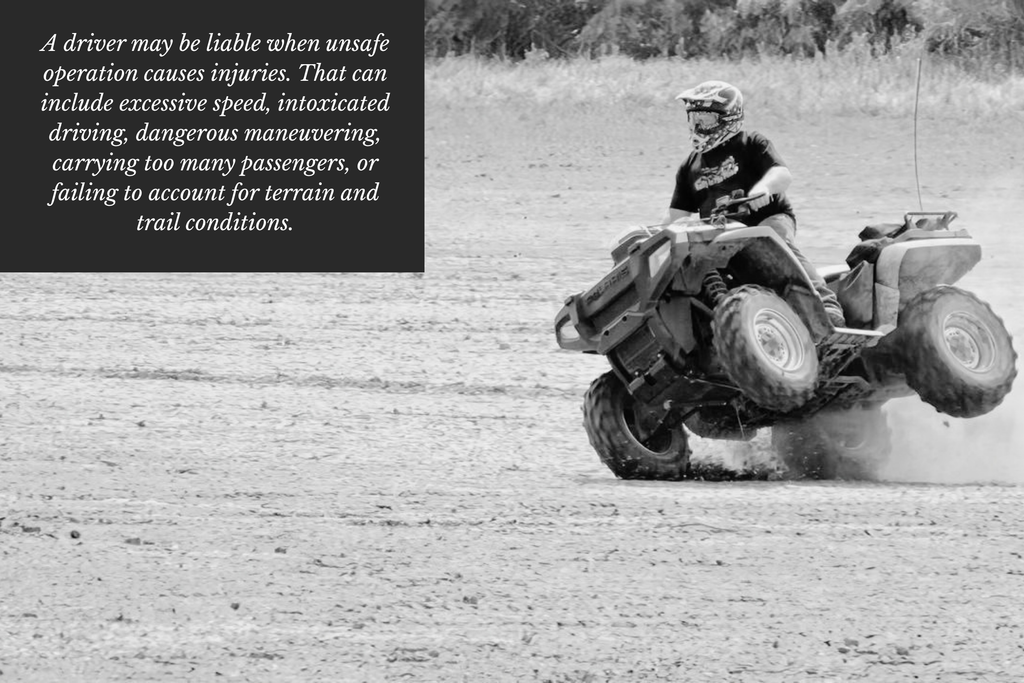
A driver may be liable when unsafe operation causes injuries. That can include excessive speed, intoxicated driving, dangerous maneuvering, carrying too many passengers, or failing to account for terrain and trail conditions.
The ATV Owner
The owner may be responsible in some circumstances when an unsafe ATV is provided to another person or necessary maintenance has been ignored. If a crash appears to involve brake, steering, suspension, tire, or throttle failure, maintenance records can help determine whether the problem should have been discovered before the accident.
A Property Owner or Business
ATV accidents also occur on farms, trails, rental properties, recreational facilities, and other private land. Depending on the circumstances, dangerous property conditions, poorly marked hazards, negligent supervision, or unsafe rental practices could contribute to an accident.
The ATV or Parts Manufacturer
A defective component can cause brakes to fail, a throttle to stick, steering to malfunction, or a vehicle to catch fire. A design defect can also make an ATV unreasonably dangerous even when used as intended.
What Should You Do After an ATV Accident?
Your health comes first after an ATV accident. Get medical attention even if you think your injuries are minor, since concussions, internal injuries, and soft-tissue damage are not always obvious right away.
If you are able, begin collecting evidence that can help with your case:
- Take photos of the ATV, the accident scene, nearby roads or trails, hazards, and your injuries. Rural accident scenes can change quickly, particularly on farms, unpaved roads, and private property, so documenting the area early can help establish what happened.
- Get witnesses’ names and contact information.
- Keep copies of medical bills, repair estimates, and other accident-related records.
If a mechanical problem may have contributed to the crash, don’t repair or dispose of the ATV until it can be inspected. The vehicle itself may provide important evidence about what went wrong.
And finally, don’t wait too long to act. Many Illinois personal injury claims are subject to a two-year statute of limitations, although different rules can apply in cases involving minors, government entities, or other special circumstances. Evidence can also become harder to preserve over time as vehicles are repaired, surveillance footage is deleted, and witnesses’ memories fade.
What If You Were Partially Responsible?
Illinois uses a modified comparative-negligence rule. An injured person who is 50% or less responsible for an accident may still recover compensation, but the award is reduced according to that person’s percentage of fault. For instance, if you were speeding or riding in a restricted area when another vehicle hit you, your compensation may be reduced by 20% if your negligence contributed to the accident.
Someone found more than 50% responsible generally cannot recover damages.
What Compensation Can an ATV Accident Victim Recover?
A serious ATV injury can create costs that continue long after the initial emergency room visit. Depending on the case, compensation may include:
- Medical expenses and future treatment
- Surgery and rehabilitation
- Medical equipment or home modifications
- Lost wages
- Reduced future earning capacity
- Emotional distress
- Pain and suffering
- Permanent disability or disfigurement
- Loss of enjoyment of life
When an ATV accident results in death, surviving family members may also be able to pursue compensation through a wrongful death claim.
In other circumstances, insurance companies may offer a settlement before you know how fully you will recover. That can make it difficult to tell whether the amount will cover future treatment, lost income, or lasting limitations. Before accepting an offer, it helps to understand the trade-offs between handling an injury claim yourself and working with a lawyer.
Talk to an Illinois ATV Accident Lawyer
ATV accidents can raise questions about driver negligence, roadway laws, insurance coverage, property conditions, and mechanical defects. More than one party may also share responsibility for the same accident.
At Kane Personal Injury, we investigate serious accidents, identify potential sources of compensation, and evaluate both the immediate and long-term effects of an injury.
If you or a family member has been injured in an ATV accident, contact Kane Personal Injury today for a free consultation.